



Shoppers no longer search the same way they did a few years ago. AI-powered search results, voice queries, and visual search are shaping how people discover products. But one thing hasn’t changed: when someone is ready to buy, they still turn to search. That’s where strong ecommerce SEO creates a real advantage.
Organic search continues to be one of the most scalable and cost-effective growth channels for ecommerce brands. Unlike ads, SEO compounds over time. A well-optimized product or category page can drive revenue for months or even years.
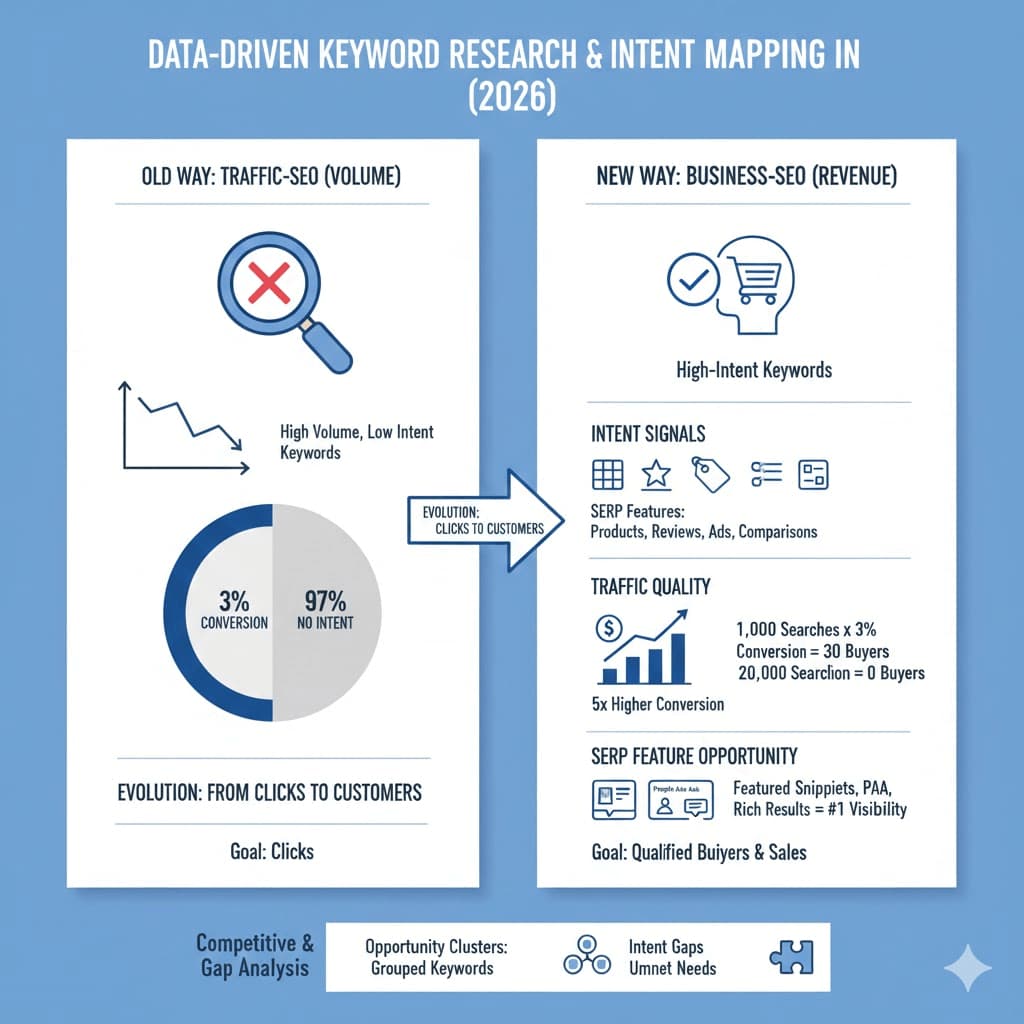
However, many stores still focus on traffic alone. That’s traffic-SEO. In 2026, winning brands focus on business-SEO—ranking for the right intent, attracting buyers, and turning visibility into sales.
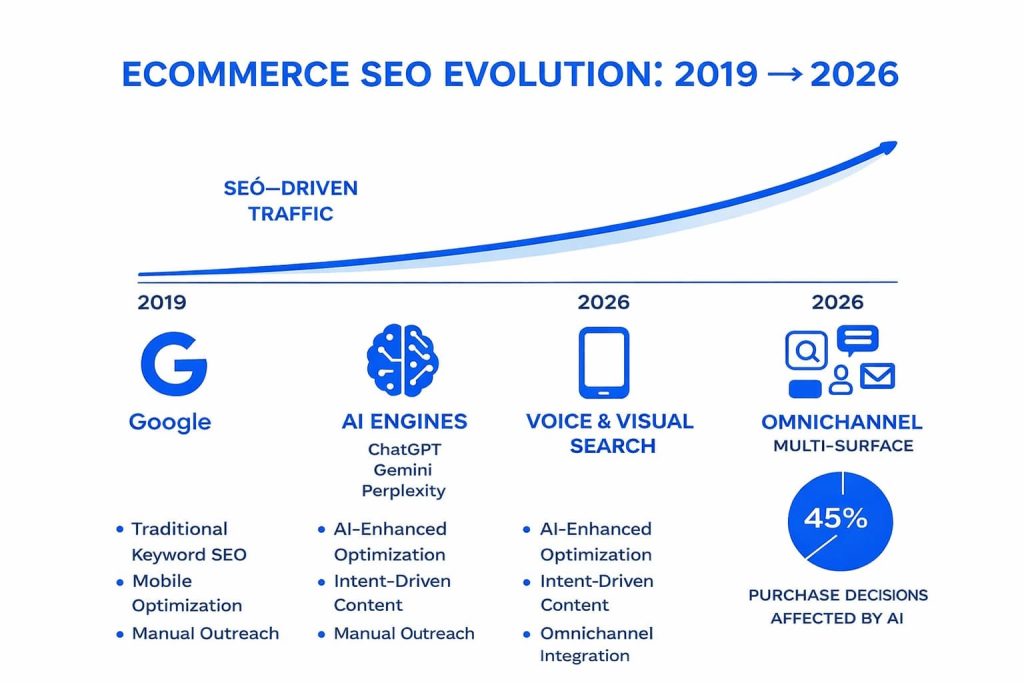
In this guide, you’ll learn how ecommerce SEO works today, what’s changed, and how to build a future-ready strategy that drives sustainable growth, not just clicks.
Understanding the 2026 Search Landscape
Search in 2026 looks very different from the classic “type a keyword, click a link” model. Ecommerce brands now compete inside smarter, faster, and more visual search experiences.
Google Search Generative Experience (SGE) and ecommerce
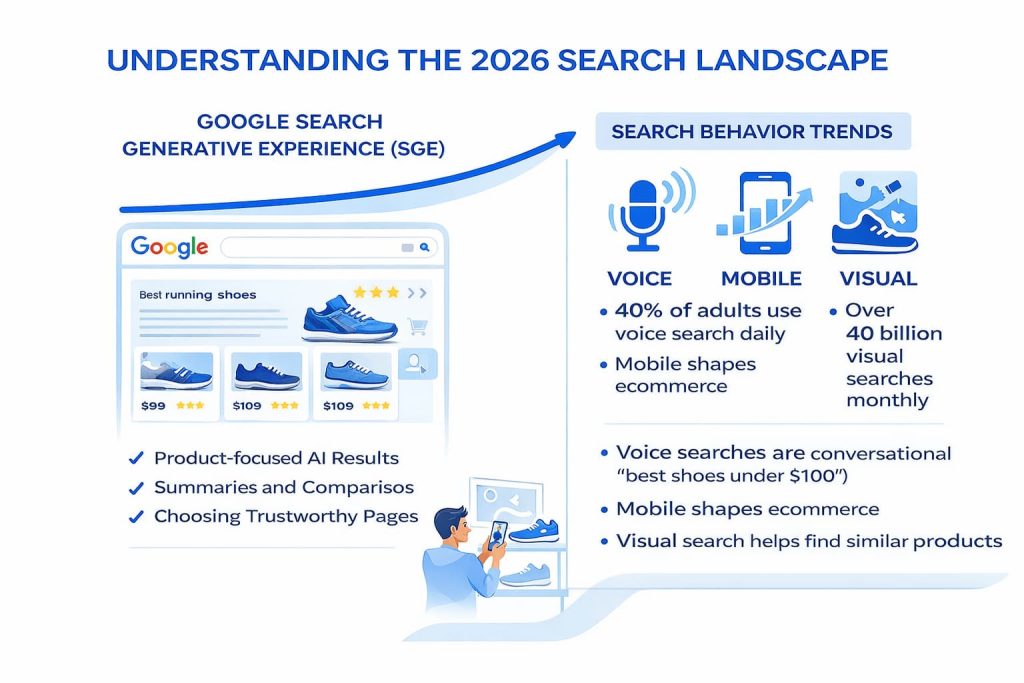
Google’s Search Generative Experience (SGE) uses AI to answer shopping-related queries directly in search results. Instead of showing only blue links, Google often highlights products, summaries, comparisons, and buying suggestions.
What this means for ecommerce SEO:
- Product pages must be clear, structured, and trustworthy
- Google pulls data from product content, reviews, pricing, and availability
- Pages that answer buyer questions clearly are more likely to appear in AI-driven responses
Search behavior is evolving across every ecommerce model—including B2B. If you sell to businesses, retention and repeat purchases matter just as much as discovery.
Learn how brands drive long-term growth using B2B loyalty programs in this complete guide with real examples and practical implementation steps.
Search behavior trends: voice, mobile, and visual
Shopping behavior continues to shift:
- Over 60% of searches now happen on mobile, shaping how product pages are designed
- Voice searches are more conversational, often intent-driven (“best running shoes under $100”)
- Visual search is growing fast, with shoppers using images to find similar products
Technical SEO — Core Principles
Technical SEO is the foundation that decides how well your ecommerce site can grow in 2026. If search engines can’t crawl, understand, and trust your site, even great content won’t perform.
Site Architecture & Crawl Efficiency
A clean structure helps both users and Google move through your store easily.
- Flat navigation: Important category and product pages should be reachable within 2–3 clicks from the homepage.
- Smart internal linking: Link from categories to products and between related products to pass authority naturally.
- Breadcrumbs: These improve navigation and help Google understand page hierarchy. Google has confirmed breadcrumbs support better crawling and SERP display.
URL Structure Best Practices
Keep URLs short, readable, and consistent. Avoid unnecessary parameters, IDs, or duplicate paths created by filters. Clear URLs improve crawl efficiency and click-through rates.
Pagination, Infinite Scroll, & SSR/ISR
Infinite scroll must still expose paginated URLs for crawlers. Server-side rendering (SSR) or incremental static regeneration (ISR) ensures product listings remain indexable and fast.
Structured Data That Unlocks Visibility
Use JSON-LD to define product details clearly. Product, Offer, Review, and FAQ schema increase eligibility for rich results. According to Google, rich results can significantly improve qualified clicks by making listings more informative and trustworthy.
Technical clarity isn’t optional in 2026—it’s a growth lever.
Data-Driven Keyword Research & Intent Mapping
Keyword research isn’t about chasing high-volume terms. It’s about understanding why someone is searching and whether that search can realistically turn into revenue.
Tools & metrics that matter in 2026
Modern keyword research focuses on intent quality, not just numbers.
- Intent signals: Look at the SERP itself. Product grids, reviews, shopping ads, and comparison pages signal buying intent. Blog-heavy results signal research mode.
- Traffic quality: A keyword with 1,000 searches that converts at 3% is far more valuable than one with 20,000 searches and no purchase intent. According to multiple ecommerce studies, high-intent keywords convert up to 5x better than informational-only terms.
- SERP feature opportunity: Featured snippets, People Also Ask, product rich results, and free shopping listings can dramatically increase visibility without ranking #1.
The goal is to prioritize keywords that match how shoppers actually make decisions.
Competitive & gap analysis
Once you understand intent, the next step is finding gaps your competitors haven’t covered well.
- Opportunity clusters: Group related keywords around a product type, problem, or use case instead of targeting single terms.
- Intent gaps: Identify keywords where competitors rank but fail to fully satisfy search intent—thin content, weak product pages, or missing comparisons.
Also Read:
Content Strategy That Converts (Beyond Keywords)
Ranking in 2026 isn’t about stuffing pages with keywords. It’s about creating content that matches how people actually buy.
Buyer journey content mapping
Every ecommerce customer moves through three clear stages:
- Awareness – “What is the best solution for my problem?”
- Consideration – “Which product or brand should I choose?”
- Decision – “Is this the right product to buy now?”
High-performing ecommerce sites create content for each stage, not just product pages. According to industry data, brands that align content with buyer intent see up to 72% higher conversion rates from organic traffic compared to traffic-focused SEO alone.
Content types that rank (and convert) in 2026
Search results today favor content that helps users decide faster. These formats consistently perform well:
Guides
In-depth buying guides and explainers build trust and attract top-of-funnel traffic.
Comparison pages
Product A vs Product B” pages capture high-intent searches and often convert better than ads.
How-to content
Practical tutorials reduce friction and position your product as the solution.
Reviews & UGC
Real customer reviews, photos, and Q&A boost credibility and influence buying decisions.
The goal isn’t more content—it’s the right content at the right moment. When your content answers questions across the full journey, SEO stops being just a traffic channel and starts driving real revenue.
Product Page Optimization — Best In Class
Product pages are no longer just pages that list features and prices. They are decision-making hubs where rankings, trust, and conversions meet. A well-optimized product page helps Google understand exactly what you sell while helping shoppers feel confident about buying.
Start with clear, original product content. Avoid using manufacturer descriptions or repeating the same copy across similar products. Instead, explain what the product does, who it’s for, and why it’s better than alternatives. Address common buyer questions directly on the page—materials, sizing, use cases, compatibility, or care instructions. This not only improves relevance but also reduces pre-purchase hesitation.
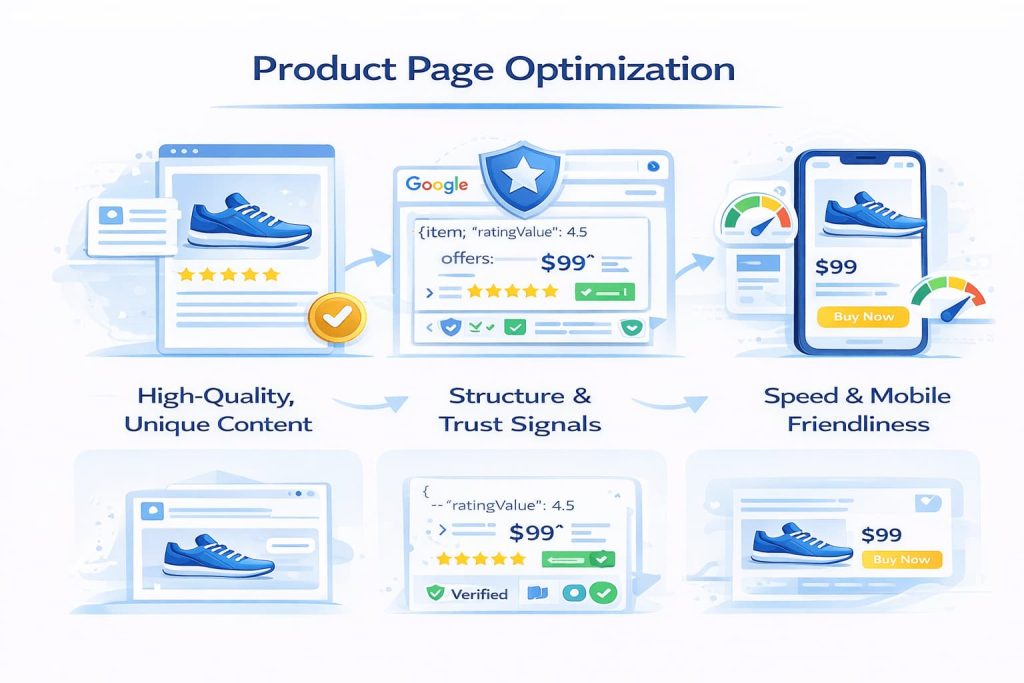
Next, focus on structure and trust signals. Use product schema to clearly communicate pricing, availability, variants, and reviews to Google. Pages with accurate structured data are more likely to appear in rich results, Shopping listings, and AI-driven responses. Display real customer reviews prominently, as they influence both rankings and conversions.
Finally, optimize for speed, mobile usability, and clarity. Most shoppers browse on mobile, and slow or cluttered pages lose sales fast.
Turn your content into conversions – explore how WPLoyalty boosts repeat sales effortlessly.
Advanced On-Page SEO Tactics for Ecommerce
On-page SEO in 2026 goes beyond keywords. The goal is to help both users and search engines understand how your store fits together—and guide shoppers smoothly toward purchase.
Alt: Advanced On-Page SEO Tactics for Ecommerce
Internal Linking for SEO + UX
Internal links pass authority and improve navigation at the same time. Pages with strong internal linking often rank better because Google understands their importance.
- Use contextual anchors (not “click here”) that clearly describe the page
- Link from blogs to relevant categories and products
- Keep links natural—1–2 per section is enough
Pages with strong internal links can see up to 40% better crawl efficiency (Ahrefs).
Related Products & Commerce Navigation
Related and “frequently bought together” sections do more than boost AOV.
- They create natural internal links
- They keep users browsing longer
- They help distribute ranking signals across product pages
Longer sessions often correlate with stronger organic performance.
Image SEO & Visual Search Readiness
Visual search is growing fast—Google reports that over 20% of searches are image-based.
- Write clear, descriptive ALT text
- Use next-gen formats like WebP or AVIF
- Compress images to improve load speed
Well-optimized images support rankings, accessibility, and conversions—all at once.
Google Merchant Center & Multi-Surface Visibility
Google Merchant Center plays a big role in how your products appear across Google in 2026 — not just in Search, but also in Shopping, Images, and AI-powered results. If your product data is clean and consistent, Google can confidently show your listings to the right shoppers at the right time.
Feed quality optimization starts with getting the basics right. Product titles, descriptions, pricing, availability, and images should always match what’s on your website. Small mismatches can limit visibility. Keep attributes detailed and accurate, and make sure your structured data (schema) on product pages matches your Merchant Center feed to avoid confusion.
With free listings and paid Shopping ads working together, you gain more surface-level exposure without relying only on ads. A well-optimized feed helps you show up organically, while paid campaigns amplify reach when competition is high. When both are aligned, visibility and conversions improve naturally.
Link Building & Authority Growth for Ecommerce
Link building in ecommerce isn’t about chasing random backlinks anymore. In 2026, it’s about earning trust from the right places. Start with niche publications your customers already read—industry blogs, product review sites, and ecommerce-focused media. A single relevant link from these sources often beats dozens of generic ones.
Next, lean into brand collaborations. Partner with complementary brands for joint guides, bundles, or campaigns. These naturally earn high-quality links while also putting your products in front of a warm, relevant audience.
Content syndication and partnerships work well when done selectively. Repurpose high-performing guides or research on trusted platforms, making sure links point back to your core pages.
Finally, don’t ignore blogger outreach and reviews. Send products to credible creators who genuinely review items in your niche. Authentic reviews not only bring backlinks, but also drive referral traffic and build long-term brand authority.
The goal isn’t volume—it’s relevance, credibility, and consistency.
AI & Automation in Ecommerce SEO
AI is now part of everyday ecommerce SEO—but the stores that win in 2026 are the ones that use AI as an assistant, not a replacement.
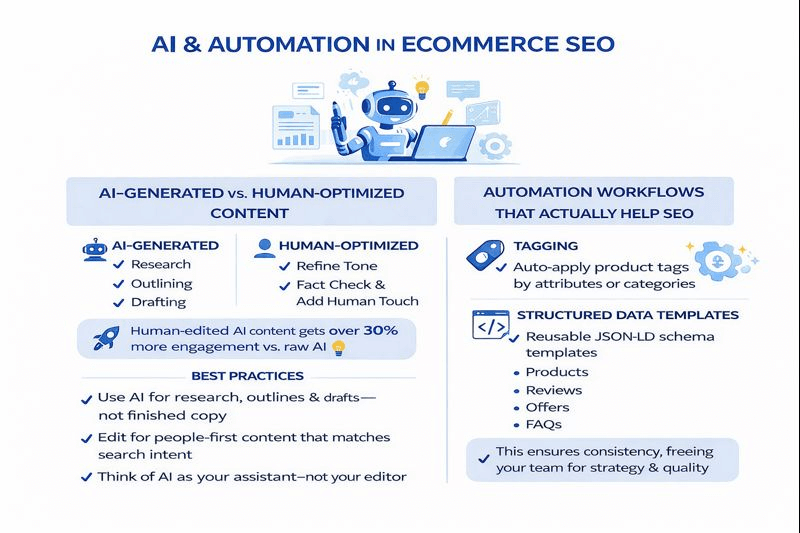
AI-Generated vs. Human-Optimized Content
AI can speed things up, but human judgment still drives rankings and conversions.
Best practices
- Use AI for research, outlines, and first drafts, not final copy
- Let humans refine tone, add real examples, and ensure accuracy
- Optimize for search intent, not just keywords
Google has been clear: content must be helpful, original, and people-first. In fact, sites hit by recent core updates often relied on mass-generated, lightly edited AI content. On the flip side, a 2024 Semrush study found that human-edited AI content outperformed raw AI content by over 30% in engagement metrics.
Editorial guardrails
- One primary search intent per page
- Manual fact checks for specs, pricing, and claims
- No duplicate or templated descriptions across products
- Clear value beyond what competitors already say
Think of AI as your junior writer—not your editor-in-chief.
Automation Workflows That Actually Help SEO
Automation shines when it removes repetitive work.
- Tagging: Automatically apply product tags based on attributes, categories, or behavior
- Structured data templates: Reusable schema templates for products, reviews, offers, and FAQs
This ensures consistency at scale while freeing your team to focus on strategy, UX, and content quality—where humans still win.
International & Multilingual SEO
Selling across borders isn’t just about translating your site—it’s about searching the way each market searches.
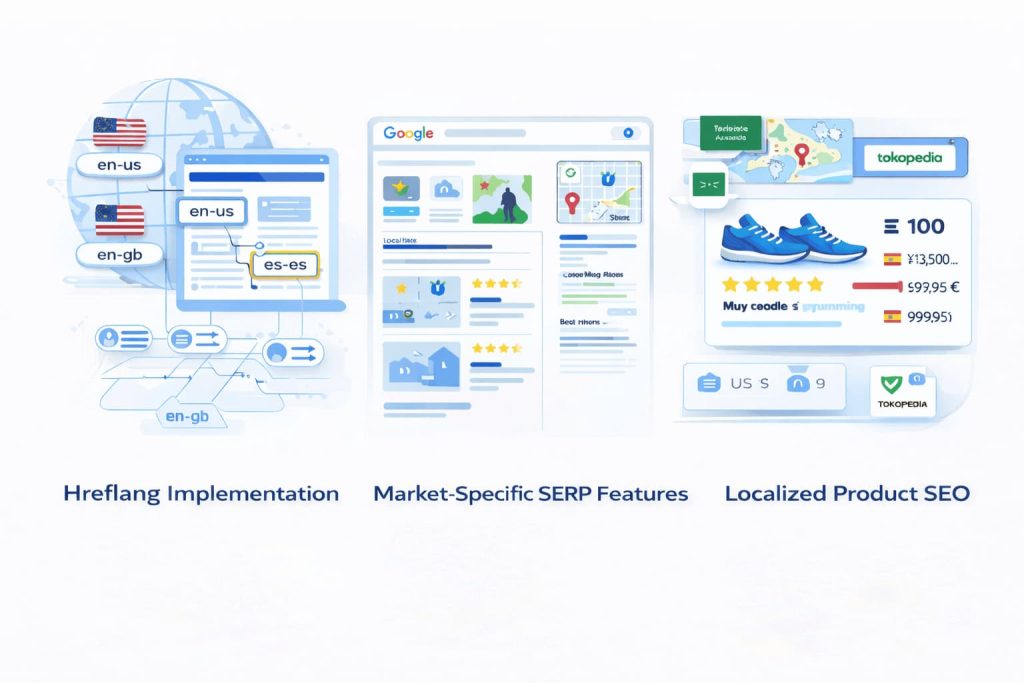
Hreflang Implementation
Hreflang tells Google which version of a page to show to which audience. Done right, it prevents duplicate content issues and improves local rankings.
Best practices:
- Use language + region codes (for example, en-us, en-gb)
- Ensure hreflang URLs are indexable and canonical
- Keep hreflang tags fully reciprocal across versions
Even small mistakes here can cause the wrong pages to rank in the wrong countries.
Market-Specific SERP Features
Search results look different by region. Some markets show more:
- Shopping results
- Local packs
- Review snippets
- Marketplace listings
Always analyze local SERPs, not just global keyword data, before planning content or categories.
Localized Product SEO
High-performing international stores localize more than language:
- Prices, currencies, and measurements
- Product naming conventions
- Reviews from local customers
Localized relevance builds trust—and trust drives both rankings and conversions.
Analytics, KPIs & SEO Metrics That Matter in 2026
In 2026, ecommerce SEO measurement is no longer about “average position.” It’s about how search visibility turns into real revenue — and that requires combining multiple tools, not relying on one dashboard.
Ranking Signals You Should Track
Intent performance (via GSC + Ahrefs / Semrush)
Start in Google Search Console. Segment queries by intent — informational, commercial, transactional — and track clicks and impressions separately. A drop in traffic often isn’t a ranking issue; it’s an intent mismatch. Tools like Ahrefs and Semrush help validate this by showing keyword intent, SERP volatility, and ranking distribution across intent types.
SERP feature & AI visibility
- Featured snippets
- Product rich results
- People Also Ask
- AI Overviews and brand mentions
Ahrefs and Semrush now surface AI Overview presence and brand citations, helping you track whether your products or pages are being referenced even when users don’t click.
Conversion KPIs That Actually Matter
Assisted organic conversions (GA4): SEO rarely converts on the first visit. Use GA4’s conversion paths and assisted conversion reports to see how organic search supports purchases alongside email, paid, or direct traffic.
Organic LTV & behavior insights: Track repeat purchases and revenue by source in GA4, then use Microsoft Clarity to watch real user sessions from organic traffic. This reveals where SEO traffic drops off, hesitates, or converts — insights rankings alone can’t show.
In short, winning ecommerce SEO in 2026 means tracking visibility, intent, behavior, and revenue together — not in isolation.
Want to measure what truly drives repeat sales? Read our guide on Key Loyalty KPIs to track the real success of your loyalty program.
SEO Governance & Maintenance Checklist
SEO isn’t a one-time project. It’s an ongoing system that needs ownership, routines, and clear checkpoints. Stores that win organic traffic long-term treat SEO like infrastructure, not a campaign.
Monthly SEO Tasks
Every month, focus on performance and hygiene:
- Review Google Search Console for drops in clicks, impressions, and indexing issues
- Track keyword movement and SERP changes using Ahrefs or Semrush
- Monitor AI Overview and brand mentions for priority product and category terms
- Check top landing pages in GA4 for traffic vs conversion changes
- Use Microsoft Clarity to spot UX friction on high-traffic SEO pages
These quick checks help catch issues before they impact revenue.
Quarterly Technical Audits
Every quarter, run a deeper technical review:
- Crawl the site (Ahrefs / Semrush) to find broken links, redirect chains, and orphan pages
- Review Core Web Vitals and mobile usability in GSC
- Audit structured data errors and Merchant Center feed issues
- Re-evaluate crawl budget, pagination, and faceted URLs
Quarterly audits prevent silent SEO decay, especially on growing catalogs.
Evergreen Content Refresh Framework
SEO content expires faster in 2026. Every 3–6 months:
- Update stats, screenshots, and examples
- Re-align content with current search intent and SERP layout
- Expand sections that lost rankings or AI visibility
- Improve internal links to newer products and categories
A clear governance process turns SEO from reactive fixes into predictable, compounding growth.
Increase repeat purchases and lifetime value with WPLoyalty
Ecommerce SEO in 2026 is no longer about chasing algorithms or publishing content in isolation. It’s about building a system that Google can clearly understand, shoppers can trust, and your business can scale.
The framework is simple, but execution is not. Start with strong foundations—clean site architecture, crawl-friendly URLs, and structured data that clearly communicates product information to Google. Layer this with intent-driven keyword targeting, where content is mapped to how customers actually search, not how brands want to rank.
From there, focus on conversion-focused SEO. Product pages, category pages, and informational content should work together, supported by reviews, internal linking, and Merchant Center visibility across multiple Google surfaces. Measure what matters using GSC, GA4, Ahrefs, Semrush, and behavioral tools like Microsoft Clarity, so SEO decisions are tied to revenue, not vanity metrics.
Finally, treat SEO as an ongoing practice. Monthly monitoring, quarterly technical audits, and regular content refreshes ensure your site stays competitive as search evolves—especially with AI Overviews and zero-click results becoming the norm.
Related Reads

