


Dropbox’s referral program stands as one of the most successful viral growth stories in the tech world.
In 2008, Dropbox was a small startup with big dreams and an even bigger problem: how to get people to trust its cloud storage solution.
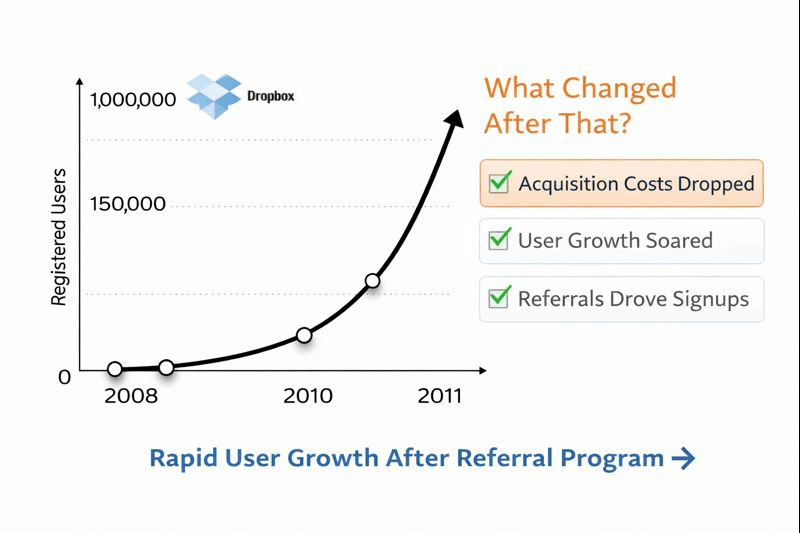
Fast forward to 2010, and Dropbox’s referral program had grown the company by 3900%, taking it from 100,000 users to over 4 million in just 15 months.
Dropbox used the power of word-of-mouth and product-centric rewards to scale its user base exponentially.
This blog breaks down the Dropbox referral program in full detail. You will learn how it started, how it worked step by step, why it succeeded. You will also see the exact growth timeline, design decisions, psychological triggers, and economic logic behind the system.
Increase your ROI upto 20X with WPLoyalty’s customized referral campaigns and reward your loyal customers.
Dropbox Before the Referral Program
Dropbox launched as a simple cloud storage product with a bold promise. It lets you store files online and access them from any device. The idea sounded useful, but convincing people to trust their files to the cloud was hard.
Before the referral program, Dropbox had around one hundred thousand registered users. Growth moved slowly. Most users came from tech forums, word of mouth, and small marketing experiments.
Paid advertising created a bigger problem. Dropbox spent close to three hundred dollars to acquire a customer who paid around ninety nine dollars per year.
People hesitated to upload personal files to an online service. They needed reassurance from friends, not banners or ads.
This stage forced Dropbox to rethink growth from the ground up. The team needed a system that reduced acquisition cost, built trust, and scaled automatically.
The Core Problem Dropbox Needed to Solve
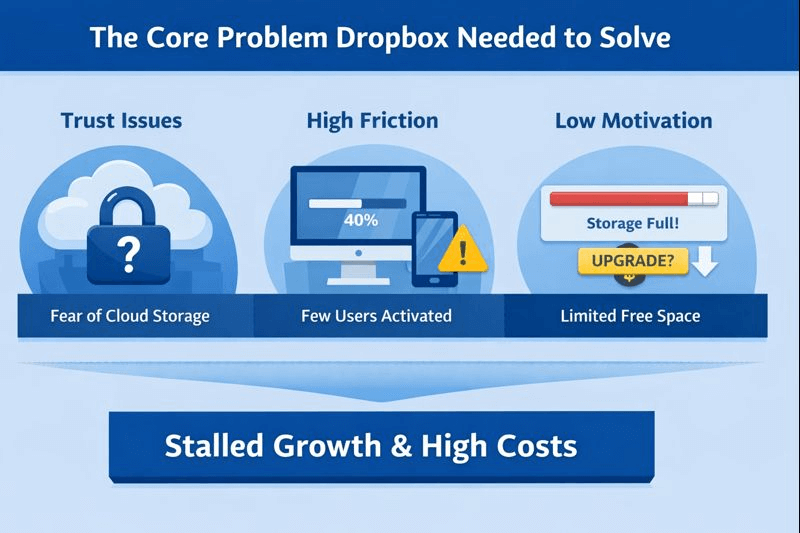
- The first issue was trust. Users felt nervous about storing files on someone else’s server. Ads could not fix this fear. Only recommendations from people they trusted could reduce that risk.
- The second issue was friction. Cloud storage showed its real value only after users installed the app, synced files, and used it daily. Many users signed up but never completed this journey. Without activation, growth stayed shallow.
- The third issue was motivation. Free users had limited storage. Once they hit the limit, they felt pain. Upgrading cost money, and many users hesitated. Dropbox needed a way to convert this pain into action without forcing a payment.
These three problems shaped every decision that followed. Dropbox needed trust at scale, lower friction, and a strong reason for users to act. The referral program solved all three at once.
Why Dropbox Chose Referrals Over Paid Ads
Dropbox made a clear decision based on numbers, not opinions. Paid advertising looked scalable on the surface, but the unit economics failed badly. Referrals fixed what ads could never solve.
Key Reasons Dropbox Rejected Paid Ads
- Paid ads cost Dropbox around $300 to acquire one paying customer, while the average customer paid about $99 per year
- Scaling ads meant scaling losses, not growth
- Ads failed to build trust, which mattered deeply for cloud storage adoption
- Ad driven users showed lower activation and retention compared to referred users
- Growth stopped the moment ad spend stopped
These numbers forced Dropbox to search for a system that worked without cash burn.
Why Referrals Made More Sense
- Referral rewards used storage space, which had low marginal cost
- The incentive directly increased product usage
- Friends removed trust barriers instantly
- Each new user could bring more users, creating compounding growth
- Referral growth continued without ongoing spend
The First Version of the Dropbox Referral Program
Dropbox launched the first version of its referral program in 2008. The team kept it simple. No complex rules. No confusing rewards. The product explained the benefit in one line.
After signup, Dropbox showed users a clear message. Invite friends and get more storage. Your friend also gets more storage. The value felt immediate and practical.
How the First Version Worked
- Every user received a unique referral link
- The user shared the link with friends by email
- The friend signed up using the link
- Both users earned extra free storage space
- Dropbox verified signup through email and desktop install
This flow removed friction at every step. Users did not need to understand marketing terms. They only needed to understand storage.
Why the First Version Converted Well
- The reward solved a real pain point
- The benefit appeared inside the product, not in ads
- The language focused on value, not promotion
- The reward triggered instantly after completion
Dropbox framed the referral program as a feature, not a campaign. Users saw it as a way to improve their account, not as a task for the company.
More info: 5 Best WooCommerce Referral Plugins (2025)
How the Dropbox Referral Program Worked Step by Step
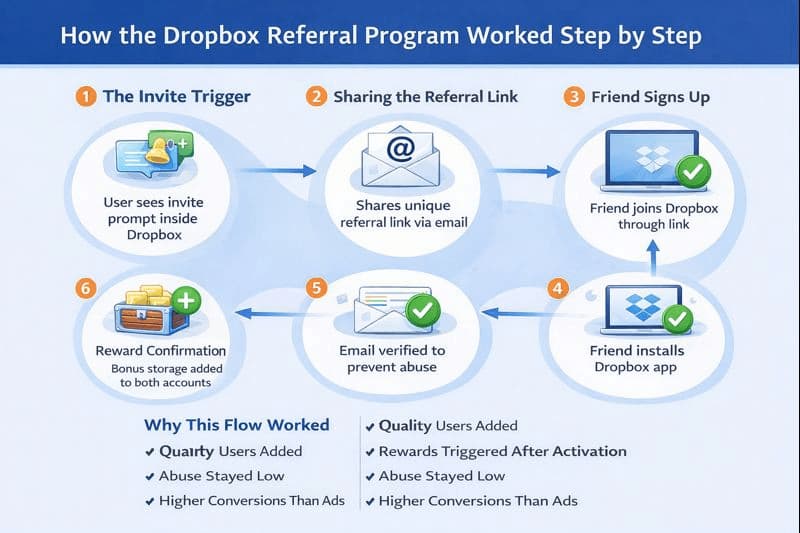
The Dropbox referral program followed a strict and intentional flow.
Step 1: The Invite Trigger
Dropbox prompted users to invite friends at high intent moments. These moments included onboarding, storage limit warnings, and account setup screens. Users already felt the value of the product at this stage.
The message stayed short and direct. Get more space. Invite friends.
Step 2: Sharing the Referral Link
Each user received a unique referral link. Dropbox encouraged sharing through email first because email matched how people shared tools at work and school.
The sharing flow stayed inside the product. Users did not need to copy long URLs or leave Dropbox. Fewer steps meant higher completion.
Step 3: Friend Signs Up
The invited friend clicked the referral link and created a Dropbox account. The signup process stayed clean and fast. Dropbox removed unnecessary form fields to reduce drop offs.
At this point, no reward triggered yet. Dropbox waited for real activation.
Step 4: Desktop App Installation
Dropbox required the new user to install the desktop app. This step mattered. It filtered low intent signups and increased product adoption.
Installing the app turned a signup into a real user. File sync created a habit. Habit created high retention rates.
Step 5: Email Verification
Dropbox asked users to verify their email address. This prevented abuse and fake referrals. It also ensured Dropbox could communicate with users later.
Only after verification did the system move forward.
Step 6: Reward Confirmation
Once all steps completed, Dropbox added bonus storage to both accounts. The reward appeared instantly. Users saw the extra space reflected in their account.
Instant reward reinforced behavior. Users felt progress. Many shared again.
Why This Flow Worked
- Every step increased user quality
- Rewards only triggered after real activation
- Abuse stayed low
- Referral traffic converted better than ads
Why Dropbox Used Storage Instead of Cash
Dropbox never treated referrals like a payout system. The team treated referrals like a product upgrade path. Storage solved a real customer pain point without damaging the business model.
Cash rewards create two issues.
- They attract the wrong users and,
- increase acquisition costs linearly.
Dropbox avoided both by offering storage, which users already wanted.
Storage Matched the Product’s Core Value
Dropbox sold storage and file sync. Extra storage made the product more useful from day one. Users uploaded more files, synced more devices, and built habits faster.
A reward that increases usage increases retention. Retention increases lifetime value. This loop strengthened the business with every referral.
Storage Had Near Zero Marginal Cost
Giving extra storage did not scale costs the way cash did. Infrastructure costs rose slowly compared to user growth. This allowed Dropbox to reward loyal customers without burning cash.
This decision turned referrals into a sustainable growth engine. Growth increased while costs stayed controlled.
Storage Filtered for High Quality Users
People who wanted more storage wanted the product. People who wanted cash wanted the reward. Dropbox chose the former.
This filtering effect mattered. Referred users activated faster, stayed longer, and upgraded more often than users from ads.
How Dropbox Built the Viral Loop
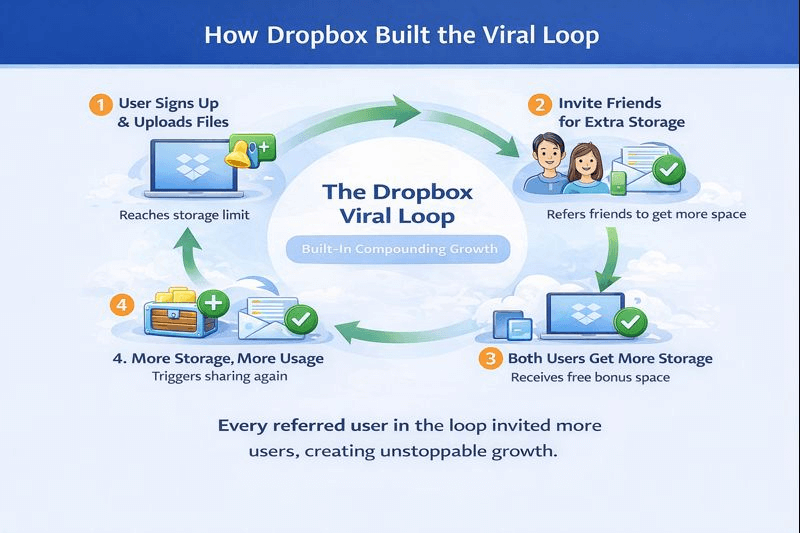
The viral loop started when users felt value or pain. Low storage triggered action. The referral offer appeared exactly at that moment. Users invited friends to solve their own problems.
The Dropbox Viral Loop Explained
Here is the exact loop Dropbox engineered:
- User signs up and starts using Dropbox
- User uploads files and approaches the storage limit
- Dropbox prompts the user to invite friends for more space
- Friend signs up and installs the app
- Both users receive extra storage
- Increased storage leads to more usage
- More usage creates new referral triggers
The loop fed itself. Each new user entered the same path.
The Exact Growth Timeline of the Dropbox Referral Program
Dropbox growth followed a clear sequence of events, each driven by product decisions and referral mechanics. The timeline shows how small changes compounded into massive scale.

2007 to Early 2008: Pre Referral Phase
- Dropbox launched publicly and crossed around 100,000 registered users
- Growth relied on tech forums, word of mouth, and limited ads
- Customer acquisition costs stayed high
- Activation and trust remained weak
The product worked, but growth stayed flat.
Mid 2008: Referral Program Launch
- Dropbox launched the first version of the referral program
- Users received extra storage for inviting friends
- Rewards applied only after signup, install, and verification
This marked the first visible shift in the growth curve.
2009: Compounding Begins
- Referral driven signups increased month after month
- Storage limits pushed users to invite more friends
- Paid acquisition became less important
Growth stopped depending on marketing spend and started depending on usage.
2010: Viral Loop Takes Over
- Dropbox crossed 1 million users
- Referrals contributed a large share of daily signups
- Users began inviting multiple friends, not just one
The curve steepened sharply during this phase.
2011: Exponential Scale
- Dropbox crossed 4 million registered users
- The company achieved around 3900 percent growth in roughly 15 months
- At peak, about 35 percent of daily signups came from referrals
The referral program became the primary growth engine.
Dropbox Referral Program vs Modern Referral Tools
Dropbox built its referral program from scratch. Modern teams rarely do. The goals stay the same, but the execution has changed.
What Dropbox Built Manually
Dropbox engineered every part of the system in house. The team controlled triggers, rewards, verification, and abuse prevention directly inside the product.
- Referral logic lived inside the core product
- Rewards tied strictly to product usage
- Verification required install and email confirmation
- Growth insights came from internal analytics
This approach gave Dropbox full control. It also required deep engineering effort.
What Modern Referral Tools Provide Today
Modern referral tools package these systems into ready to use platforms. They reduce build time and make experimentation easier.
- Pre built referral flows and templates
- Automated reward delivery
- Fraud detection and referral validation
- Dashboards for referral performance
- Easy A B testing on incentives
Teams can launch in days instead of months.
Set multiple rewards and campaigns for various customer actions including referrals using WPLoyalty’s customizable loyalty programs.
Conclusion
The Dropbox referral program succeeded because it solved a real business problem with a product decision. Dropbox did not chase growth. It removed friction that blocked growth and let users do the rest.
Every element worked toward one goal. Reduce trust barriers. Lower acquisition costs. Increase real usage. The referral program did all three at the same time. It rewarded behavior that already made sense for users and pushed them deeper into the product.
Also read:

