


Not all WooCommerce points and rewards plugins are built equal. Some charge a premium for features buried behind add-ons.
Others offer a generous free tier but cap out when you need to scale.To keep things fair, we installed and tested all five plugins on the same WooCommerce test store.
We’ve listed our own limitations alongside our strengths, including real criticisms from our WordPress.org reviews. We encourage you to test any plugin on a staging site before committing your money.
Who This Guide Is For (And Who Should Skip It)
This guide is for WooCommerce store owners who want to add a points and rewards loyalty system to their store and need help picking the right plugin.
Read this if you:
- Run a WooCommerce store and want customers to earn points for purchases, referrals, reviews, or other actions
- Are comparing plugins and need an honest breakdown of what each actually does (and doesn’t do)
- Want to know the real pricing – not just the headline number, but what you actually pay for the features you need
Skip this if you:
- Use Shopify (these plugins are WooCommerce-only; check Smile.io or LoyaltyLion for Shopify)
- Are still deciding whether a loyalty program makes sense for your store – we have a separate guide on that: [ Why You Should Consider Using Loyalty Programs?]
- Just want a quick answer: see the comparison table below
How We Evaluated These Reward Point Plugins for WooCommerce?
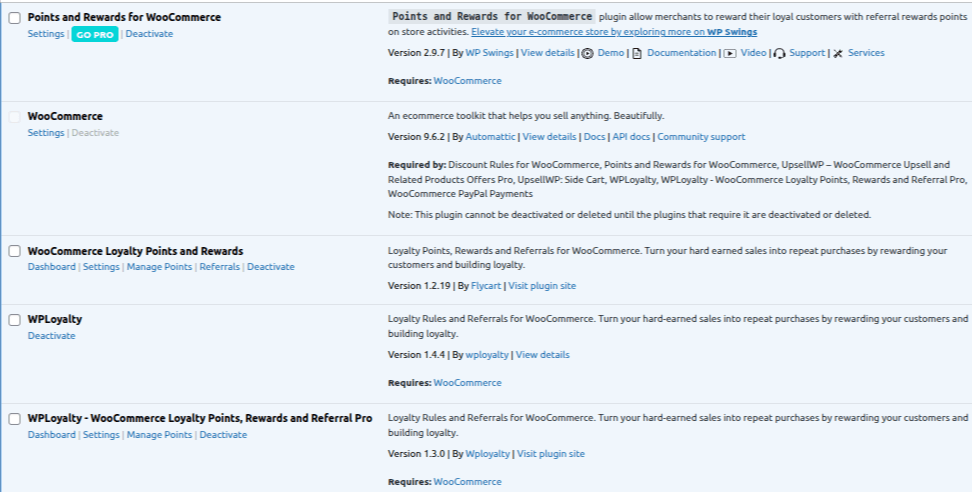
We installed each plugin on a clean WooCommerce test environment and ran them through real scenarios.
Our test setup:
- WordPress [6.0 or higher]
- WooCommerce
- Starter theme (to avoid theme conflicts)
- WooCommerce sample product data (simple and variable products)
What we measured:
- Setup time – Clock starts at plugin activation, stops when we complete setting up the loyalty program.
- Feature depth – We tested: points for purchases, points for signups, referral programs, tiers/levels, point expiry, reward types (discounts, free products, free shipping), multi-currency, and more.
- Pricing transparency – We documented the real annual cost including required add-ons or paid extensions needed for common features.
- WooCommerce compatibility – Tested with WooCommerce [INSERT VERSION], block-based checkout, and HPOS (High-Performance Order Storage). Also checked for conflicts with popular plugins (WPML, popular themes).
- Real-world usability – How clear is the admin dashboard? How does the customer-facing experience look? Is the documentation actually helpful when you get stuck?
Quick Answer: Which Plugin Should You Pick?
Not every store owner has time to read all the words. Here’s the short version. Tap any card to see why we recommend it.
Which Plugin Should You Pick?
Not every store owner has time to read all the words. Here’s the short version.
Tap any card to see why we recommend it.
Disclosure: WPLoyalty is our product. This table reflects our honest assessment after testing all 5 plugins.
Pricing verified March 2026. Tap each card for details.
Still not sure?
Use our WooCommerce points and rewards plugin quiz below to get a personalized recommendation.
5 Best WooCommerce Points and Rewards Plugins
The Five best points and rewards plugins for WooCommerce are:
- WPLoyalty
- YITH WooCommerce Points and Rewards
- SUMO Reward Points
- WooCommerce Points and Rewards (Official)
- WP Swings
1. WPLoyalty – Best for WooCommerce Stores Wanting Conditional loyalty Campaigns + Multiple Reward Types in One Plugin
WPLoyalty is a points and rewards plugin for WooCommerce built by Flycart – the same team behind Discount Rules for WooCommerce (300,000+ active installs).
It currently holds a 5/5 rating from 230+ reviews on WordPress.
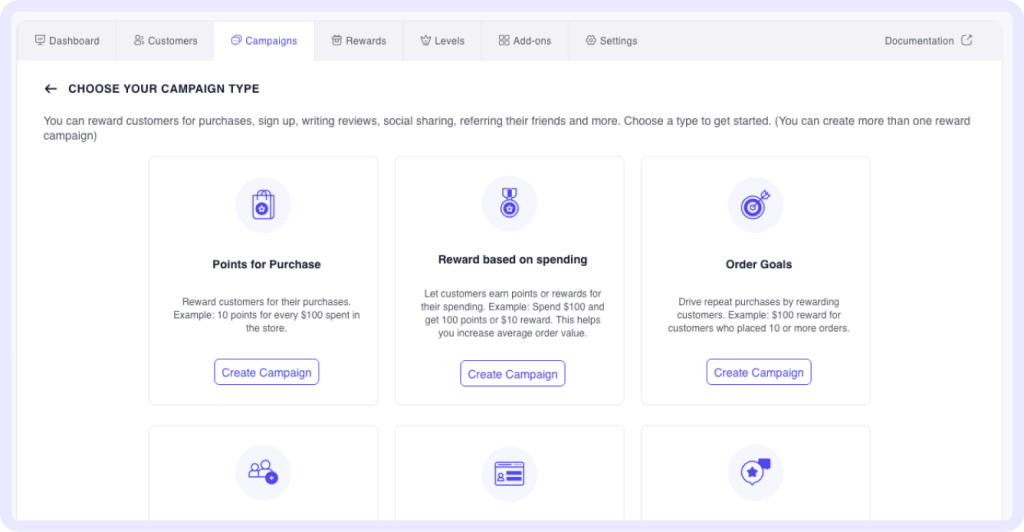
Best for: WooCommerce stores wanting conditional campaign logic, multiple reward types, referrals, tiered program and more in one plugin. Especially strong for stores already using Flycart’s Discount Rules.
Not ideal for: Stores needing external automation (webhooks), deep gamification (badges/leaderboards), or WhatsApp/SMS notifications. Overkill for stores that just need basic “earn points, get discount.”
What WPLoyalty has and does Well
- 12+ campaign types: Points for purchase, reward based on spending, referral, sign up, write a review, birthday, social share, and achievement (level up, daily login)
- 5 reward types: Point conversion, fixed discount, percentage discount, free product, free shipping
- 20+ conditional rules: Filter campaigns by user role, customer level, cart subtotal, and more
- Referral / Refer-a-friend: Set up referral programs with unique referral links per customer.
- VIP levels / Tiers: Unlimited loyalty levels with custom names, descriptions, badge images, and point thresholds.
- Point expiry + email reminders: Set expiry periods for earned points; automatic email notifications before points expire
- Launcher widget: Floating chat-style panel on storefront showing points balance, available rewards, referral link, and ways to earn
- Customizable rewards page: Dedicated loyalty landing page with brand-matched colors, fonts, and layout
- Customer management dashboard: View/edit/import/export customer points, filter by level or activity
- Manual point adjustment: Add or deduct points for individual customers
- CSV import/export: Bulk import or export customer point balances
- Email notifications:Automatic emails on points earned, rewards unlocked, and points expiring
- Multi-currency support: Earn and redeem points in customer’s local currency via popular WooCommerce multi-currency plugins
- Multi-lingual support: WPML compatible; dynamic string translation add-on available for campaign/reward descriptions
- Reward reversal: Customers can return rewards and get their points back
- Guest Referral: Referred friends receive their reward coupon instantly on email submission usable on their first order.
Pricing
- Free version available
- Starter – $105/yr for 1 site
- Professional – $155/yr for 3 sites
- Agency – $295/yr for 10 sites
Honest limitations
- No webhook support. Cannot send point events to external tools like Make.com or Zapier.
- No gamification. No badges, leaderboards, or competitive elements.
Run a loyalty program with a floating launcher widget, VIP tiers, birthday rewards, and multiple reward redemptions in minutes with WPLoyalty.
2. YITH WooCommerce Points and Rewards – Best for Gamification + the YITH Ecosystem
YITH is one of the largest WooCommerce extension developers with 100+ plugins that integrate with each other.
Their Points and Rewards plugin works the best when you’re already running YITH Membership, YITH Affiliates, or YITH Reviews – the cross-plugin connections create value no standalone loyalty plugin can match.
With 30,000+ stores and a 4.2/5 rating from 120+ reviews, it’s battle-tested at scale.
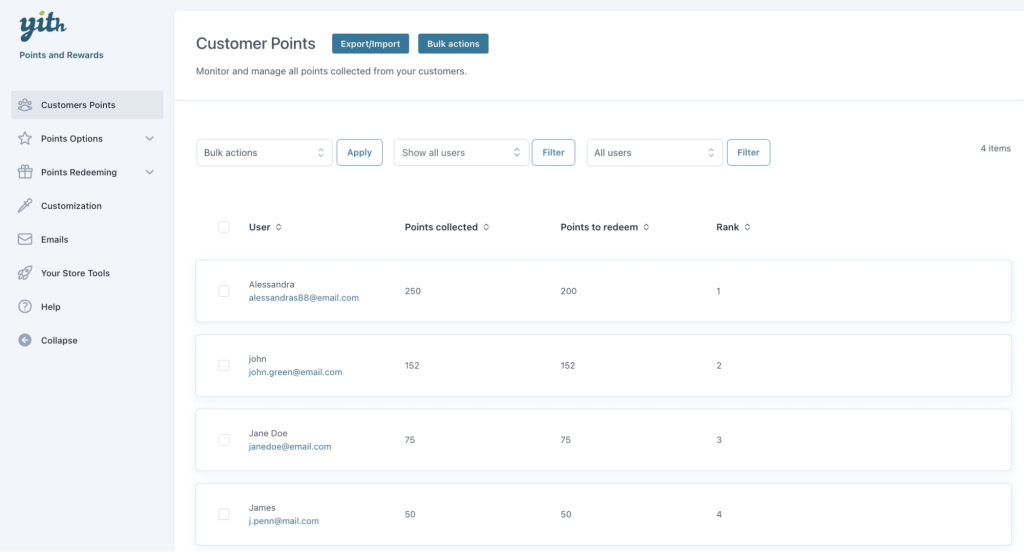
Best for: Stores already using 2+ YITH plugins. Stores wanting deep gamification – badges, leaderboards, competitive tier visibility. Mid-to-large stores who are comfortable with complex configuration.
Not ideal for: Small stores wanting quick, simple setup. Budget-conscious stores not already in YITH.
What YITH Has and Does Well
- Points for purchases, signups, reviews, referrals, birthdays, and spending thresholds
- Gamification: Custom badges with colors/images, public leaderboards, level progress banners on My Account – the strongest gamification of any plugin on this list
- Role-based point rules: Different earning rates for different customer groups
- Loyalty levels with tiered rewards and auto-upgrade
- Point expiry with email notifications
- Retroactive points: Award points for all past orders when you first install
- CSV import/export for migration
- YITH ecosystem integration: Points tied to YITH Membership plans, affiliates earn points on sales, reviews via YITH Advanced Reviews count automatically
Pricing
- No free version – YITH discontinued the free tier; this is a premium-only plugin now
- Premium – €139.99/yr (~$150 USD) for 1 site
Honest Limitations
- Overwhelming for simple use cases. If you just need basic points-for-discounts, you’ll wade through settings you don’t need.
- Expensive as a standalone. ~$150/yr for a single site – the priciest option unless you’re already in the YITH ecosystem.
3. SUMO Reward Points – Best One-Time Payment Option
SUMO stands out for two unique things: a one-time pricing model (no annual subscription) and a user-to-user point sharing feature that no other plugin on this list offers. It’s sold on CodeCanyon/Envato, not WordPress.
Currently is holds 7000+ installs with 4.6 rating.
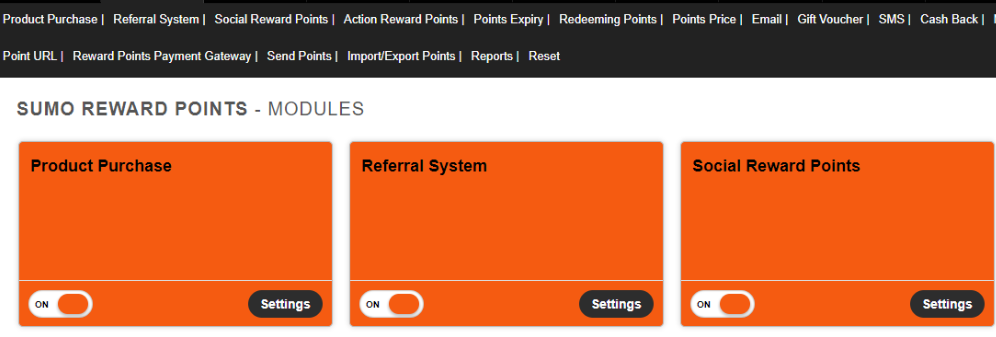
Best for: Budget-conscious stores that prefer paying once. Community-driven stores where user-to-user point sharing adds real value.
Not ideal for: Stores wanting a polished customer-facing UI, rapid security updates, or a dedicated loyalty launcher widget.
What SUMO Has and Does Well
- Points for purchases, signups, reviews, referrals, and social sharing
- User-to-user point transfer: Customers can send their points to other customers – genuinely unique across all six plugins
- Product-level, category-level, and global-level point rules
- Tier-based loyalty levels for rewarding high-value customers
- Point expiry with notification
- Birthday reward points (added January 2026)
- Reward types: Fixed and percentage discount coupons
- Referral program with unique links
- SMS notifications via Twilio gateway (extra cost for gateway)
Pricing
- No free version
- Regular License – $49 one-time (CodeCanyon; includes 6 months support)
- Extended Support – ~$16 extra (extends to 12 months)
Honest Limitations
- CodeCanyon distribution. No auto-updates from WordPress dashboard unless you install Envato’s updater plugin.
- No launcher widget or customer-facing loyalty portal. Points are only visible on the My Account page.
4. WooCommerce Points and Rewards (Official) – Best for Simple Setup + Guaranteed Compatibility
This is the official loyalty extension from the WooCommerce team, sold on WooCommerce.com.
Its biggest advantage is something no third-party plugin can match: guaranteed 100% compatibility with WooCommerce core, including block-based checkout and HPOS (High-Performance Order Storage).
Best for: Store owners who want the absolute simplest loyalty setup with zero learning curve and guaranteed WooCommerce compatibility.
Not ideal for: Anyone wanting referrals, tiers, point expiry, gamification, or anything beyond basic points-for-discounts.
What the Official Plugin Has and Does Well
- Points for purchases, signups, and reviews
- Global earning rate: Set X points per $1 spent (can override at product or category level)
- Global redemption rate: Set X points = $1 discount
- Maximum discount cap at cart, category, or product level
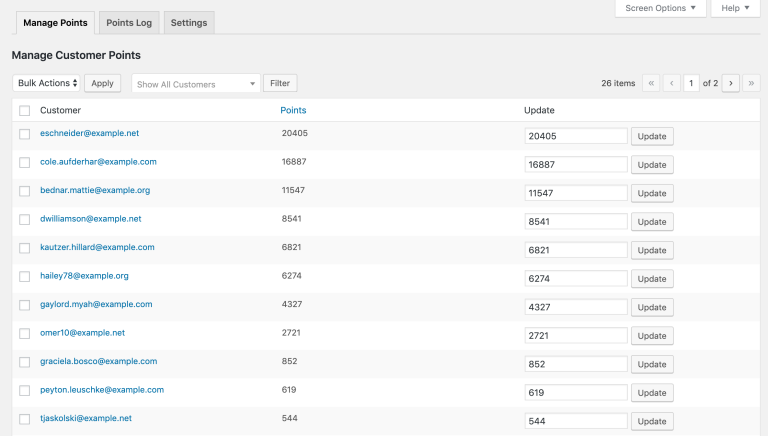
- Manual point adjustment from admin dashboard
- Points log showing all customer activity
- Block-based checkout compatible (confirmed by WooCommerce team)
Pricing
- No free version
- Single Site – $179/yr
Honest Limitations
- Very basic feature set. No referrals. No tiers. No birthday rewards. No social sharing. Points can only be redeemed for discounts – no free products, no free shipping.
- No point expiry. No built-in way to expire points or send reminders.
5. WP Swings – Best Free Reward Points Plugin for WooCommerce
WP Swings offers the most generous free version of any reward points plugin on this list. Features that competitors lock behind $100–$200/yr paywalls – referrals, membership levels, badges, gamification spin wheel – are included at no cost.
With 7,000+ active installations and a 4.5/5 rating on WordPress.org, it has a solid and growing user base.
Best for: Store owners who want to test a real points program with referrals, levels, and gamification at zero cost.
Not ideal for: Stores needing deep conditional campaign logic, a dedicated launcher widget.
What WP Swings Has and Does Well
- Points for purchases, signups, referrals, reviews, and social sharing
- Membership levels with badges – multiple tiers at no cost
- Gamified spin-to-win wheel – interactive popup where customers win random point rewards
- Retroactive points for past orders – existing customers get credit when you install
- WhatsApp + SMS notifications for point updates
- Klaviyo integration – sync points data to Klaviyo for targeted marketing
- API access for custom integrations
- Birthday rewards and quiz-based campaigns
Pricing
- Free
- 1 Site plan – $99/yr
- 5 Sites plan – $199/yr
- 10 Sites plan – $409/yr
Honest Limitations
- No conditional campaign engine. Global and category-specific rates only.
- Smaller support community. At ~7,000 installs, fewer forum discussions and third-party tutorials than WPLoyalty or YITH when you get stuck.
- Less polished admin interface. Dashboard works but settings are sometimes buried in non-obvious places.
What We’d Pick for Different Store Types
We make WPLoyalty. Obviously, we think it’s great. But, recommending our own product when a competitor is genuinely better for your situation would destroy the trust. So here’s our honest take:
If you’re already using 2+ YITH plugins: Get YITH Points & Rewards. The ecosystem integration alone is worth the premium.
If you want to test before you commit: Start with WP Swings’ free tier. It’s genuinely generous. Run it for 3–6 months, see if your customers engage, then decide whether to upgrade to their Pro ($99/yr) or switch to a different plugin. You can always migrate point balances via CSV.
If you want dead-simple and official: WooCommerce Points and Rewards. You’ll pay more for fewer features, but you’ll never worry about compatibility. If “it just works, no surprises” is your priority, this is it.
If you want to pay once and move on: SUMO. $45, done. Annual subscriptions aren’t for everyone, and SUMO’s one-time model is a valid (reasonable) choice.
If you want the deepest WooCommerce-specific loyalty features in one plugin: WPLoyalty. Conditional campaigns, referral programs, VIP tiers, birthday rewards, point expiry, free product rewards, launcher widget – all from one plugin.
Final Words
Based on this comparison of WooCommerce points and rewards plugins, the next step is to shortlist two or three plugins that match your store’s specific needs and test them on a staging environment before committing.
Prioritize features you’ll actually use. Avoid being swayed by feature counts – a plugin with 30 capabilities you won’t touch is worse value than one with 10 you will. Map your must-haves against the pricing column, and account for renewal costs, not just the first year.

