


Ecommerce churn rate measures how many customers stop buying from your online store over a specific period.
People often associate churn with subscription boxes or SaaS businesses, but it also affects traditional ecommerce stores.
Omniconvert found that these stores lose an average of 77% of customers after their first purchase. That means only 23 out of every 100 first-time buyers ever return to shop again.
Even more compelling, repeat customers generate 300% more revenue than first-time shoppers while accounting for only 21% of your customer base, according to data from Gorgias analyzing 10,000+ ecommerce brands.
In this blog, you’ll learn:
- What ecommerce churn rate means
- Why it matters for your business
- How to calculate it even without a subscription model
- Industry benchmarks across different verticals
- The common reasons customers leave
- Five proven strategies to reduce eCommerce customer churn rate
Increase your ROI upto 20X with WPLoyalty’s customized loyalty campaigns and reward your loyal customers.
What is Ecommerce Churn Rate?
Ecommerce churn rate represents the percentage of customers who stop purchasing from your online store during a specific time period. It’s also called customer attrition rate.
Subscription-based companies like Netflix and Dollar Shave Club popularized the concept of churn. In today’s eCommerce trends, customers churn closely because it’s essential for achieving sustainable revenue growth.
- For subscription-based businesses, this is when customers cancel their subscriptions.
- For non-subscription businesses, it’s when a customer fails to return after their first purchase.
- Churn can either be customer churn (the number of lost customers) or revenue churn (the loss of revenue when customers stop buying). Here is an example: If you lose 10 customers who each spent $50 monthly, your customer churn is 10 but your revenue churn is $500. If instead you lose one customer who spent $600 monthly, your customer churn is just 1 but your revenue churn is $600.
Subscription stores regularly track their churn. Non-subscription businesses can also calculate churn by using metrics such as repeat purchase rate and cohort analysis.
Voluntary vs. Involuntary Churn: Two Different Problems
Customers churn for different reasons. When you understand those differences, you can identify the right problems to fix.

Voluntary churn signals deeper problems with your product quality, customer experience, or value proposition that require strategic customer solutions.

Involuntary churn often stems from technical payment issues that can be prevented with the right solutions and proactive communication.
Why Ecommerce Churn Differ from SaaS Churn?
Subscription-based businesses can pinpoint the exact moment a customer churns because the customer actively cancels their recurring payment. SaaS companies like Slack or Zoom know the exact time someone clicks “cancel subscription” and stops being a paying customer.
Ecommerce stores without subscriptions face a tougher challenge because customers don’t formally cancel, they simply stop coming back. Instead of relying on a cancellation date, you define churn based on your typical repeat-purchase cycle.
The difference: A fashion retailer might treat a customer as churned after 12 months of inactivity, while a coffee subscription service might flag churn after just 45 days.
Despite this added complexity, calculating your churn rate remains possible and valuable for understanding customer retention and lifetime value. The cohort analysis method, which we’ll explore in detail later, provides reasonably accurate churn measurement for non-subscription ecommerce stores.
Why Ecommerce Churn Rate Matters for Your Business
Customer lifetime value drops dramatically when people only buy once and never return to your ecommerce store.
When AWAY Luggage analyzed their customer data, they discovered that reducing churn by just 10% added $4.2 million to their annual recurring revenue. Their story demonstrates the exponential power of customer retention over acquisition.
Here are few more reasons why churn rate in eCommerce matters:
The Staggering Impact on Profitability
Research from Bain & Company reveals that a 5% increase in customer retention produces more than a 25% increase in profit. Some businesses see profit increases as high as 95% from that same 5% retention improvement.
These numbers prove that reducing your churn rate delivers exponential returns compared to the linear growth from acquiring new customers.
The mathematics of retention are compelling: if you acquire 1,000 customers monthly but lose 800 of them (80% churn), you’re running in place. Lower that churn to 70%, and suddenly you’re adding 100 net customers monthly instead of 200 gross.

Lower Customer Acquisition Costs Through Retention
Customer acquisition costs continue climbing year after year as digital advertising becomes more competitive and expensive.
Facebook CPMs have increased 89% since 2020, while Google Ads costs rose 75% in the same period.
U.S. companies lose $136.8 billion annually from avoidable customer churn and switching to competitors, according to Forrester research.
Retained customers also become your best marketers through word-of-mouth referrals and positive reviews.
This creates a virtuous cycle where low churn rates reduce acquisition pressure while high-value customers naturally attract more shoppers like themselves.
Building Sustainable Business Growth
Businesses that focus exclusively on new customer acquisition operate on a “leaky bucket” model that’s impossible to sustain. You constantly pour resources into filling the bucket while existing customers drain out through the holes at the bottom.
Reducing customer churn creates predictable, recurring revenue even without a formal subscription model.
Industry Benchmarks: What’s a Good Churn Rate?
Different product categories naturally experience vastly different retention patterns based on purchase frequency and product lifespan.
Sephora’s Beauty Insider program maintains an impressive 80% retention rate in the highly competitive beauty industry where the average is only 38%.Their unique selling point comes from their personalized loyalty rewards and recommendations.
Average Churn Rates Across Ecommerce Verticals
Here’s a detailed breakdown of average churn rates across major ecommerce categories:
Low Churn Industries (Better Retention):
- Beauty and Fitness: 62% churn rate
- People and Society: 63% churn rate
- Food and Drinks: 64% churn rate
- Health: 65% churn rate
Medium Churn Industries:
- Books and Literature: 69% churn rate
- Pets and Animals: 70% churn rate
- Sports: 70% churn rate
- Apparel: 71% churn rate
High Churn Industries (Lower Retention):
- Home and Garden: 75% churn rate
- Toys and Hobbies: 77% churn rate
- Shoes: 78% churn rate
- Apparel Accessories: 79% churn rate
- Consumer Electronics: 82% churn rate
- Gifts and Special Events: 82% churn rate
How to Calculate Ecommerce Churn Rate
Calculating your ecommerce churn rate accurately provides the foundation for all retention improvement efforts.
The calculation method differs significantly between subscription-based and traditional ecommerce models, so we’ll cover both approaches.
Formula for Subscription-Based Ecommerce
Subscription businesses have the easiest path to calculating churn since customers actively cancel their recurring payments.
The basic formula accounts for customer changes over a specific period while excluding new customer acquisition from the calculation.
The subscription churn rate formula:
(Customers at Start of Period – Customers at End of Period + New Customers Acquired) / Customers at Start of Period × 100
Here is a practical example. Your subscription box starts January with 500 customers. By the end of January, you have 520 total customers. During the month, you acquired 50 new subscribers.
Calculation: (500 – 520 + 50) / 500 × 100 = 30/500 × 100 = 6% monthly churn rate
This means 6% of your existing customers cancelled their subscriptions in January.
Calculating Churn for Non-Subscription Ecommerce Stores
Traditional ecommerce stores face a bigger challenge since there’s no clear cancellation moment when someone simply stops buying.
The solution is using customer cohort analysis combined with your average repeat purchase timeline.
Step-by-step process for non-subscription churn calculation:
Step 1: Determine Your Average Repeat Purchase Timeline
Start by analyzing your order data to find how long customers typically wait between purchases. Export orders from repeat customers and calculate the average number of days between their first and second order.
Step 2: Define Your Customer Cohorts
Group customers based on the date of their first purchase rather than when they cancelled. Each cohort represents all customers who made their first order during a specific period.
Step 3: Track Cohort Behavior Over Time
Monitor each cohort for twice the length of your average repeat purchase timeline. If customers typically reorder every three months, track each cohort for six months.
Step 4: Calculate Churn Percentage
Count how many customers from the cohort made at least one additional purchase within your tracking window. Everyone who didn’t reorder is considered churned. Divide the number of churned customers by the total cohort size and multiply by 100 for your churn percentage.
Practical Example: Apparel Brand Churn Calculation
Let’s calculate churn for an online clothing store. Analytics show customers typically reorder four months after their first purchase, so we’ll track cohorts for eight months (double the timeline).
The Spring 2024 cohort (April) had 2,500 first-time customers. By December 2024, only 750 made additional purchases, meaning 1,750 never returned.
Churn calculation: (2,500 – 750) / 2,500 × 100 = 70% churn rate
This means you retained 30% of first-time buyers. Compared to the apparel industry average of 71% churn, you’re performing typically for your vertical. This baseline enables measuring future retention improvements.
5 Common Reasons Why Customers Churn
Here are five common reasons why customers churn:
1. Poor Customer Experience and UX Issues
Slow loading times cause 40% of visitors to abandon a website after just three seconds of waiting. Mobile-unfriendly designs alienate the 60% of online shoppers who browse primarily on smartphones and tablets.
Navigation problems leave customers unable to find products they want to buy. Confusing menu structures, poor search functionality, and unclear product categorization all contribute to customer frustration.
Accessibility issues exclude customers with disabilities while creating poor experiences for everyone else.
2. Checkout Friction and Payment Problems
Complex multi-step checkouts that require excessive information drive cart abandonment rates above 70% industry-wide. Shoppers lose patience when forced to create accounts, fill out lengthy forms, or navigate confusing payment screens.
Limited payment method acceptance causes involuntary churn. Modern shoppers expect multiple payment choices including credit cards, debit cards, PayPal, Apple Pay, Google Pay, and buy-now-pay-later services.
Shipping costs and delivery times also drive voluntary churn at the checkout stage. Long delivery windows (over 5-7 business days) push customers toward competitors offering faster shipping, especially for time-sensitive purchases.
3. Product Quality Concerns
Poor product quality leads to high churn rates and negative word-of-mouth. When items arrive damaged, break quickly, or fail to match product descriptions, customers feel deceived.
Customer complaints, returns, and negative reviews provide early warning signs of quality issues.
Inconsistent quality across different products damages trust even when some items meet expectations. Customers expect reliable quality standards across your entire catalog.
One bad experience refuses to solve customer’s pain points and causes them to churn soon.
4. Lack of Personalization and Engagement
Sending the same email blasts to all customers regardless of their purchase history or preferences signals that you don’t understand or value individual needs.
This lack of personalization makes customers feel like transaction numbers rather than valued individuals.
Infrequent or purely transactional communication also contributes to customer churn. When you only contact customers to promote sales or announce new products, you’re not building relationships.
5. Competition and Pricing Pressures
Better offers from competitors constantly tempt your customers to switch brands. When rivals provide similar products at lower prices, faster shipping, or superior service, customers have little reason to remain loyal.
Price sensitivity varies by product category but remains a significant churn factor across all industries.
Aggressive competitor marketing also pulls customers away through targeted acquisition campaigns. Without strong retention strategies you’re vulnerable to these competitive raids on your customer base.
How to Identify At-Risk Customers Before They Churn
Preventing churn costs far less than winning back lost customers. Spot early warning signs to intervene before customers leave.
Declining Purchase Frequency
- Track when customers deviate from their normal buying patterns
- Flag customers who exceed their typical repurchase window
- Use Shopify’s analytics to create automated alerts for at-risk shoppers
- Monitor cohort analysis for group-wide purchase frequency drops
Reduced Engagement Metrics
- Watch for decreasing website visits, browsing time, and pages per session
- Track email open rates and click-through rates for individual subscribers
- Monitor social media engagement (likes, comments, shares)
- Segment customers by activity level to identify those slipping away
Negative Feedback and Support Issues
- Respond immediately to negative reviews and complaints
- Track customers with multiple unresolved support tickets
- Address public social media complaints quickly with empathy
- Transform unhappy customers into loyal advocates through excellent service
Cart Abandonment Patterns
- Identify customers who repeatedly abandon carts (beyond the 70% average)
- Analyze which specific products customers abandon most
- Check if abandonment happens at the shipping calculation step
- Watch for browse abandonment from previously active buyers
Act on these signals immediately to save customer relationships before they end.
5 Proven Ways to Reduce Ecommerce Churn Rate
The five evidence-based strategies to reduce eCommerce churn rate are:
- Optimize Customer Experience Across All Touchpoints
- Build a Strategic Customer Loyalty Program
- Implement Proactive Customer Service
- Personalize Communication and Offers
- Prevent Involuntary Churn with Smart Payment Solutions
Method 1: Optimize Customer Experience Across All Touchpoints
Exceptional customer experience forms the foundation of low churn rates and high retention.
- Improve website performance and mobile experience by conducting speed audits and fixing loading bottlenecks. Compress images, minimize code, and utilize browser caching to achieve page load times under two seconds.
- Improve navigation and site architecture so customers find products effortlessly. Implement clear category structures, intuitive search with filters, and prominent calls-to-action on every page. Add easy access to customer support.
- Optimize checkout flows by removing unnecessary steps and information requirements. Offer guest checkout options alongside account creation to reduce friction. Display shipping costs early, provide multiple payment methods, and include trust signals like security badges and return policy links. Add one-click checkout solutions.
- Enhance accessibility for all users by following WCAG guidelines for web accessibility. Use sufficient color contrast and descriptive alt text. Enable keyboard navigation with clear fonts.
Method 2: Build a Strategic Loyalty Program
68% of customers join eCommerce loyalty programs, and 56% spend more even when cheaper alternatives exist.
- Implement points-based rewards where customers earn points for purchases, reviews, social shares, and other valuable actions. Make points easy to understand (1 point per $1 spent) and redemption straightforward.
- Create tiered loyalty campaigns that reward your loyal customers with escalating benefits. Bronze, silver, and gold tiers give customers something to work toward while enabling you to allocate retention resources efficiently.
- Offer experiential rewards beyond product discounts to build emotional connections with your brand. VIP shopping experiences, behind-the-scenes content, birthday rewards, and surprise bonuses create memorable moments that strengthen customer relationships.
- Use loyalty data for personalization by tracking individual preferences, purchase patterns, and engagement behaviors. Tailor email content, product recommendations, and special offers based on loyalty program data.
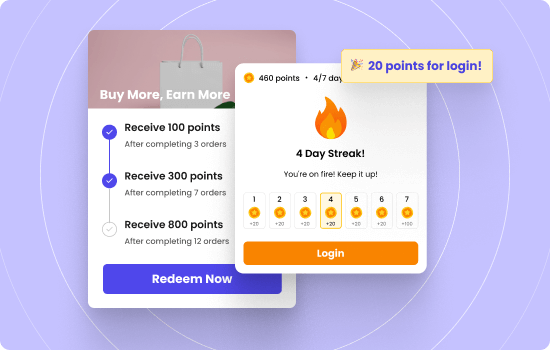
Create a customized loyalty program with multiple rewards using WPLoyalty’s easy-to-use campaigns.
Method 3: Implement Proactive Customer Service
Proactive customer service anticipates and resolves problems before customers need to reach out for help.
- Automate order updates and shipping notifications to keep customers informed throughout the fulfillment process. Send confirmations immediately after purchase, shipping notifications with tracking links, and delivery confirmations.
- Reach out proactively when problems occur rather than waiting for customers to discover issues and complain. If a product ships late, contact affected customers before they notice with honest explanations and solutions.
- Provide omnichannel support options so customers can reach you through their preferred communication method. Offer customized email, phone support, SMS, live chat, and social media messaging to meet diverse customer preferences.
- Set and meet response time expectations by establishing clear service level agreements (SLAs) and consistently delivering on them. Aim for first response times under one hour for emails, 15 minutes for social media messages, and 40 seconds for SMS.
Method 4: Personalize Communication and Offers
Personalized communication drives 3-5 times higher engagement rates than generic messages according to marketing research.
- Segment your customer base by purchase behavior, product preferences, demographic factors, and engagement levels.
- Implement behavioral email automation triggered by specific customer actions or inactions. Welcome series for new customers, abandoned cart reminders, follow-ups emails, and win-back campaigns for inactive customers all drive engagement.
- Use dynamic content that changes based on individual customer data within emails and on your website. Display recently viewed products, personalized product recommendations, and offers relevant to purchase history.
- Collect zero-party data by asking customers directly about their preferences, interests, and needs through surveys and preference centers. Use this information to refine personalization accuracy beyond what behavioral data alone reveals.
Method 5: Prevent Involuntary Churn with Smart Payment Solutions
Payment failures due to expired credit cards, insufficient funds, or technical issues cause businesses to lose revenue from customers who actually want to continue buying. Smart payment strategies recover many of these failed transactions while preventing future problems.
- Implement account updater services that automatically refresh expired credit card information for subscription customers. Visa, Mastercard, and American Express offer these services to merchants, updating stored payment information when customers receive new cards.
- Use intelligent payment retry logic that attempts failed transactions multiple times at strategic intervals. Some failures are temporary (insufficient funds, network issues) and succeed on subsequent attempts.
- Send proactive payment update reminders before cards expire or when payments fail. Email and SMS notifications asking customers to update billing information prevent involuntary cancellations.
- Offer flexible payment options including digital wallets (Apple Pay, Google Pay), buy-now-pay-later services (Klarna, Afterpay), and multiple card types.
Set multiple rewards and campaigns for various customer actions using WPLoyalty’s customizable loyalty programs.
Bottom Line
Calculating churn rate requires different approaches depending on whether you operate a subscription model or traditional ecommerce store.
Subscription businesses can measure churn directly through cancellations, while regular online stores must use cohort analysis and average repeat purchase timelines. Both methods provide actionable data for tracking retention improvements over time and comparing performance against industry standards.
The five proven strategies we’ve explored address both voluntary and involuntary churn drivers.
Also read

